Seam Rollers & Probes
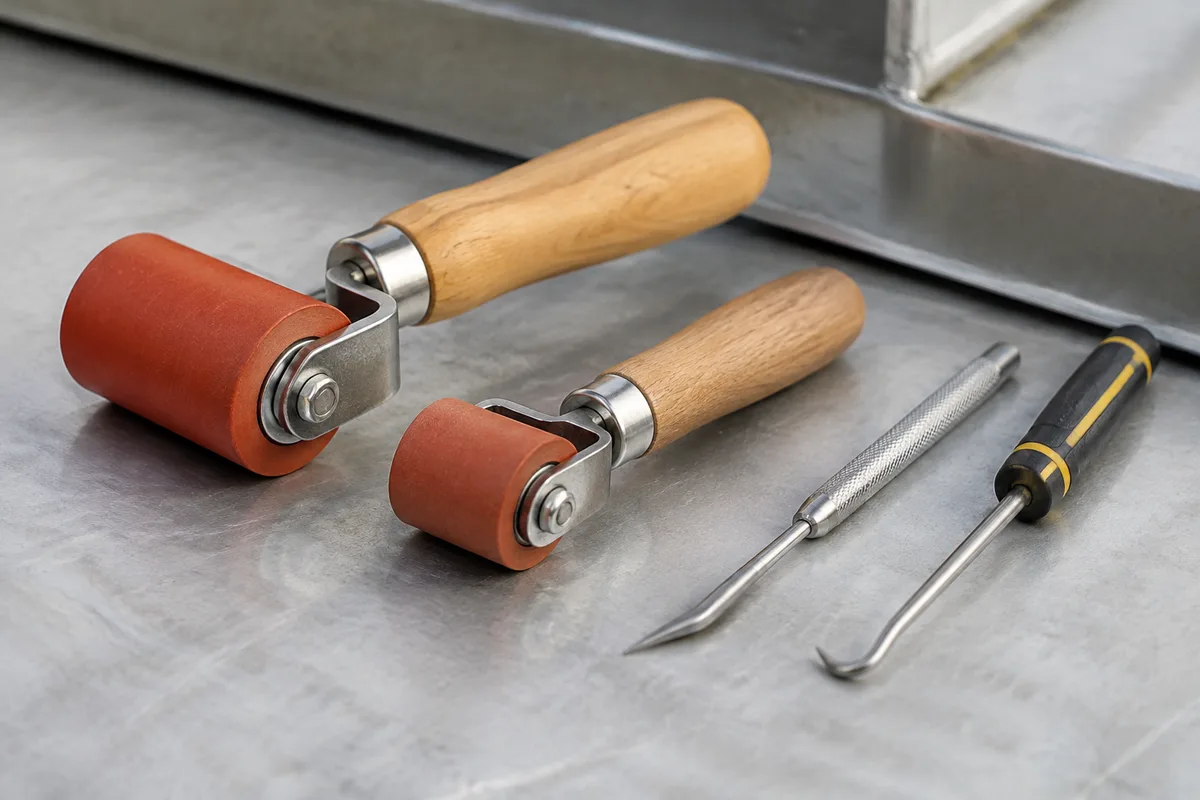
Seam Rollers & Probes
On a single-ply flat roof, the seam is the roof. Every place two sheets of membrane meet is a place water can find its way in if the weld is not complete. Seam rollers and seam probes are the hand tools used to check that work before anyone signs off on it — a simple, low-tech final step behind the heat and machinery that actually joins the membrane.
What seam Rollers & Probes is
A seam roller is a small hand roller, run along a freshly welded seam while it is still warm, that presses the two layers of membrane firmly together so the bond sets evenly across the full width of the joint. A seam probe is a blunt tool, not a blade, drawn along the same seam once it has cooled, to feel for any spot where the weld did not fully take. A probe that catches or lifts at the edge marks a spot that needs to be reheated and rewelded before the roof is considered finished.
This step exists because a hot-air or torch weld can look correct on the surface and still have a soft spot underneath — a gap in heat, a bit of dust or moisture on the membrane, a seam that was rolled too soon or not firmly enough. Rolling and probing is the way to check the actual bond rather than just the appearance of one, and it is done by hand because a hand tool is what finds a soft edge that a visual check would miss.
How we use it at SoffitSmith by Smithbuilt Roofing
On TPO, PVC, and other single-ply membrane work, our seam rolling and probing follows directly behind the hot-air welders used to fuse the membrane sheets. Every welded seam gets rolled while the weld is still warm, then probed by hand once it has cooled — before the flat roof is called finished, not as a spot check but as a pass across every run.
This step works alongside the other tools used on the same flat-roof jobs. Membrane fastening tools and stand-up screw guns set the fastening pattern that holds the field down; moisture meters and core sampling tools check what is happening underneath the membrane; and once a seam is confirmed sound, it gets logged in the same photo documentation used to record the rest of the job, so the seam work is part of the visible record rather than a step you have to take on faith.
What it means for you
For a homeowner or property owner, the value of seam rolling and probing is straightforward: it is the difference between a membrane roof that looks finished and one that has actually been checked seam by seam. A flat roof fails almost exclusively at the seams, so a step built specifically to test them addresses the part of the roof most likely to cause trouble later.
It also means less guesswork after the fact. A seam that has been probed and confirmed does not need to be a mystery a year down the line when a small leak shows up — it has already been checked once, by hand, at the time it was made. And because the check happens on every seam rather than a sample, there is no section of the roof that gets skipped for the sake of speed.
What to expect during your visit
You will not typically see seam rolling and probing as a separate appointment — it happens as part of the flat-roof installation or repair itself, in the sequence right after each seam is welded. As a crew works across the membrane, you will see the roller pass over each fresh weld while it is warm, then, once that section has cooled, a probe run along the same line to check it. Any spot that does not pass gets reheated and rewelded on the spot, then rolled and probed again.
No special preparation is needed on your end. The pace of this step depends on the length of seam involved rather than on the roof size alone, since a roof with more penetrations, valleys, or detail work will simply have more seams to check. It is quiet, hand-tool work, done low to the roof surface, and it does not add noise or disruption beyond what is already happening during the membrane installation.
Frequently asked questions
Is seam rolling and probing safe for my roof surface?
Yes. A seam roller applies gentle, even pressure to a warm weld, and a probe is a blunt tool used to feel for a weak spot, not to cut or puncture the membrane. Used correctly, neither tool damages a sound seam.
How long does this step add to a flat roof job?
It is done as each seam is completed rather than all at once at the end, so it does not add a separate block of time to the schedule. The overall pace depends on how much seam length the roof has, which relates to its size and the number of penetrations and details involved.
Is this used on every flat roof, or just some?
It is used wherever hot-air welded single-ply membrane, such as TPO or PVC, is being installed or repaired, since those are the systems that rely on welded seams. It is part of finishing that welded seam work, not an optional add-on.
Will I be able to see that the seams were checked?
The work is documented alongside the rest of the job through the same photo records used on site, so you can see the seam work that was done rather than just being told about it after the fact.
If you have a flat or low-slope roof and want to know more about how its seams are welded, rolled, and checked, reach out to SoffitSmith by Smithbuilt Roofing to talk it through.