Pneumatic Coil Roofing Nailers & Air Compressors
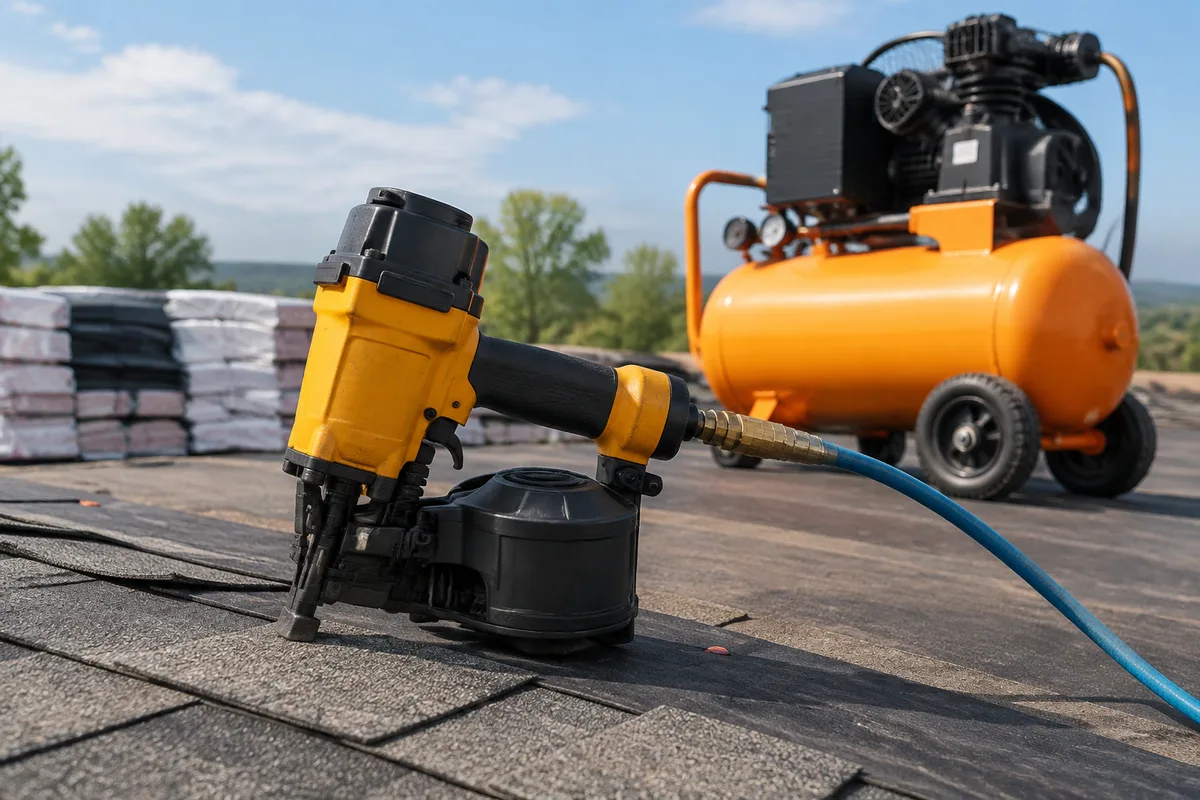
Pneumatic Coil Roofing Nailers & Air Compressors
Pneumatic coil roofing nailers and the air compressors that power them are the tools most asphalt shingle roofs are actually built with today. They drive fasteners at a set depth and speed, course after course, so a roof's wind resistance depends less on any one swing of a hammer and more on a machine calibrated to do the same thing correctly every time.
What pneumatic Coil Roofing Nailers & Air Compressors is
A coil roofing nailer holds a coiled strip of nails and drives them one after another using compressed air supplied by a job-site compressor. The installer sets the depth so each nail sinks flush with the shingle surface — not so deep that it cuts through the mat, not so shallow that it sits raised and vulnerable to being pulled loose. That depth control is the entire point of the tool.
Before pneumatic nailers were standard, shingles were often hand-nailed, which meant depth and placement varied from nail to nail and from installer to installer. A compressor and coil nailer standardize that: the same pressure, the same depth stop, and a nailing pattern that follows the shingle manufacturer's spec rather than an individual's habit. It's a small piece of equipment with an outsized effect on how a roof performs in wind.
How we use it at SoffitSmith by Smithbuilt Roofing
We use pneumatic coil nailers and air compressors on shingle work — full replacements, new construction roofing, and roof-over or overlay installations — as the primary fastening method across the field of the roof. Correct nail placement and depth on every shingle is what keeps a roof on in high wind, and that's the standard we hold the tool to on every course.
The nailers work alongside other tools on the same job: cap nailers secure the underlayment before shingles ever go down, laser distance meters and chalk lines keep courses straight so the nailing pattern lines up correctly, and roof jacks, toe boards and planks give the crew stable footing on steep slopes while they work the nailer down each row. On jobs where a fixed power source isn't practical, a towable air compressor keeps the tools running. When the shingle work is done, magnetic nail sweepers go over the yard, drive and beds to pick up stray fasteners before we leave.
What it means for you
For a homeowner, the practical benefit of pneumatic nailing is consistency. A nail driven to the correct depth by a calibrated tool holds the shingle the way it was designed to be held, course after course, rather than depending on how tired or careful a particular hand was on a particular section of roof. Consistent fastening is one of the basic things that separates a shingle roof that performs well in wind from one that doesn't.
It also means the work moves at a steady, predictable pace. Compressor-driven nailing is faster than hand-nailing, which shortens the time your roof deck is exposed to weather during a tear-off and replacement, and it keeps the crew's attention on placement and pattern instead of on swinging a hammer.
What to expect during your visit
On a day when shingle installation is underway, expect to hear the compressor running and the quick, repeated snap of the nailer as the crew works across the roof. It's a steady mechanical sound rather than the irregular hammering of hand-nailing, and it typically continues for as long as the crew is actively laying shingle courses, which varies with the size of the roof.
Before nailing starts, the roof deck and underlayment are already in place, chalk lines are set to keep courses straight, and the compressor is positioned where its hose can reach the work area without crossing walkways or landscaping. Landscape protection tarps are usually down first to keep beds and walks clear. Once the shingles are on, the crew does a final sweep with magnets to pick up any dropped fasteners before wrapping up.
Frequently asked questions
Is pneumatic nailing safe for my property?
Yes. The nailers and compressor stay on the roof and immediate work area, and the crew uses fall protection such as harnesses and anchors on steep or elevated sections while operating them. Landscape tarps go down before work starts, and a magnetic sweep afterward is meant to catch any fasteners that end up on the ground.
Will the noise be a problem?
There is mechanical noise from the compressor and the rapid nailing sound while shingles are being installed, similar to other power tool work. It runs during active daytime work hours and stops when the crew isn't actively fastening shingles.
How long does this part of the job take?
Nailing time depends on the size and complexity of the roof, since it happens continuously while each course of shingles is laid. It's one step within a larger installation timeline that also includes deck prep, underlayment, and detail work at flashings and edges.
Is this the right method for every roof?
Pneumatic coil nailers are suited to asphalt shingle roofing specifically, including new construction, full replacements, and roof-overs. Other roof types, such as metal panels or single-ply membranes, use different fastening tools altogether.
If you'd like to talk through how we approach shingle fastening on your roof, get in touch with SoffitSmith by Smithbuilt Roofing and we're glad to walk you through it.