Membrane Fastening Tools & Stand-Up Screw Guns
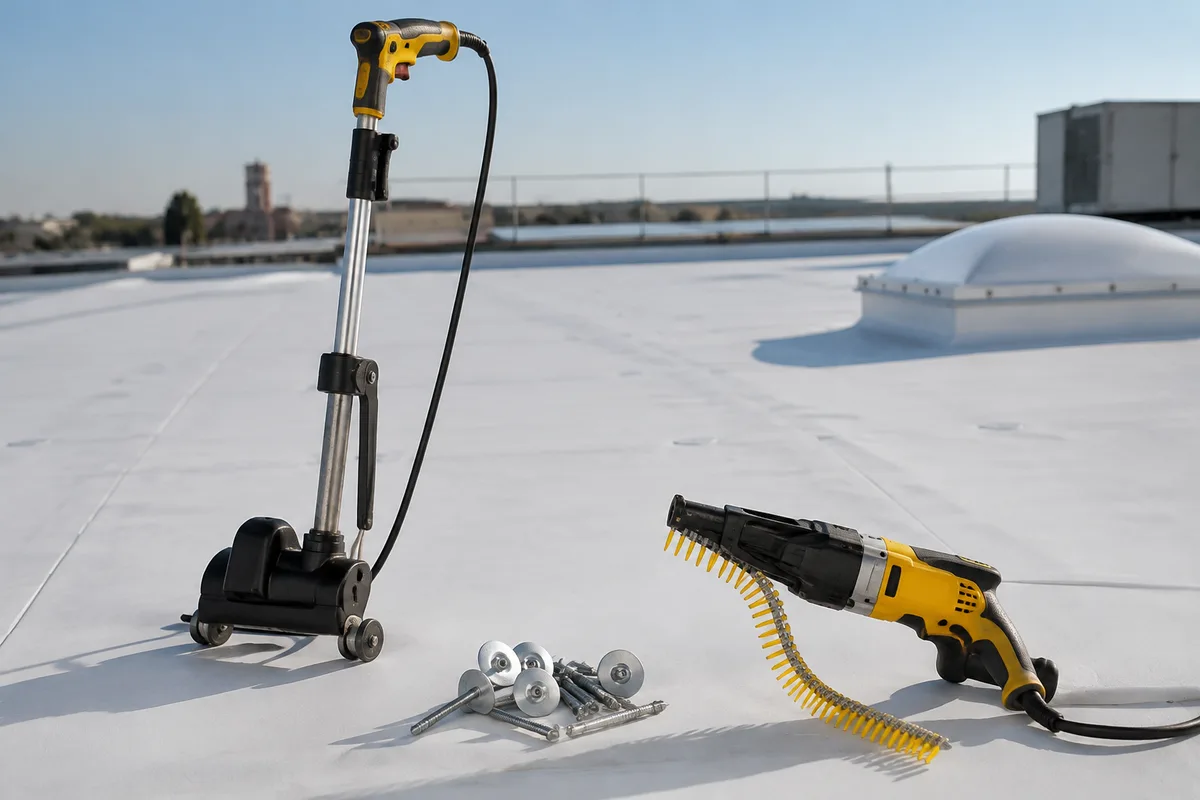
Membrane Fastening Tools & Stand-Up Screw Guns
On a flat or low-slope roof, the membrane has to be locked to the deck at a set spacing and depth, over and over, across a field that can run thousands of square feet. Membrane fastening tools and stand-up screw guns are the equipment that makes that possible without a crew kneeling and hand-driving every fastener. At SoffitSmith by Smithbuilt Roofing, this equipment is part of how we install single-ply membrane roofs to pattern, consistently, from one edge of the roof to the other.
What membrane Fastening Tools & Stand-Up Screw Guns is
Stand-up screw guns are powered, wheeled or handheld tools built specifically for setting membrane plates and fasteners into a roof deck at a fixed depth and torque. Rather than a technician bending or kneeling to drive each screw by hand, the gun is set to a spacing pattern and run along the membrane field, seating plate after plate at a consistent depth. This matters because a fastener driven too shallow can back out under wind load, and one driven too deep or at an angle can tear the membrane or fail to hold the plate flat.
This equipment replaced slower, hand-driven fastening on large single-ply roofs, where variation in depth and spacing from one worker to the next was hard to avoid. With a stand-up gun set to a manufacturer's pattern, the spacing and depth stay the same across the whole field, which is part of what a membrane roof system needs to meet its rated wind uplift performance.
How we use it at SoffitSmith by Smithbuilt Roofing
We use membrane fastening tools and stand-up screw guns on TPO, EPDM and PVC membrane installations, setting plates and fasteners to the spacing pattern the membrane system calls for across the flat-roof field. On these same roofs, hot-air welders fuse the membrane seams into a continuous sheet, and once a seam is welded, our seam rollers and probes go over it by hand to confirm it holds before we consider that section finished. Fastening, welding and probing are three separate steps on a flat roof, and each one depends on the step before it being done correctly.
Before fastening begins, we typically use moisture meters and core sampling tools to understand what is under the existing roof, since a wet or failing deck changes how and where fasteners should be placed. Laser distance meters, levels and chalk lines are used for layout, so the fastening pattern lines up correctly across the field rather than drifting as the run gets longer.
What it means for you
For a homeowner or property owner, consistent fastener spacing is not something you can see once the membrane is down, but it is one of the things that determines how the roof performs in wind. A pattern that is even across the field, rather than tighter in some areas and looser in others, is part of what a membrane roof needs to hold up over time.
Powered fastening also means less time spent on the roof deck compared with entirely hand-driven work, which can shorten the time your property has an open roof field during installation. And because the fastening pattern follows a set spec rather than individual judgment on each screw, you get the same result across a small repair section and a large commercial field alike.
What to expect during your visit
On a membrane roofing project, fastening work happens after the old roofing is removed and the deck has been checked, and it typically runs alongside membrane placement rather than as a separate visit. You will generally see the crew unroll a section of membrane, run the stand-up screw gun along the fastening pattern to set plates, then move to the next section while another part of the crew welds the seams behind them. Photo documentation through CompanyCam is used to record stages of the work as it happens, so you can see the same progress photos the crew does.
How long this takes depends on the size of the roof field, since fastening a small flat-roof section is a different job than fastening a large commercial field. There is no special preparation required on your end beyond the usual access needed for any roofing project — clear driveways and yard access for material handling and the equipment used on site.
Frequently asked questions
Is stand-up screw gun fastening safe for my property?
Fastening equipment is set to drive to a specific depth, which is part of what keeps it from over-driving into the deck or damaging structural members below. Our crews also use fall protection equipment such as harnesses, lanyards and roof anchors on elevated and steep work as a standard part of how the roof is accessed.
How long does membrane fastening take?
The time needed depends on the size of the roof field and the fastening pattern the membrane system requires, since a larger flat-roof area simply has more plates and fasteners to set. It is done as part of the overall membrane installation timeline rather than as a separate visit.
Is this only for commercial roofs?
Membrane fastening tools and stand-up screw guns are used wherever a single-ply membrane roof — TPO, EPDM or PVC — is being installed, which includes both larger commercial flat roofs and smaller flat-roof sections on residential properties, such as porch or addition roofs.
How do you know the fastening held?
Fastening is checked as part of the same process that includes welding the membrane seams and then rolling and probing those seams by hand, so the fastening pattern and the seam work are verified together before the section is considered finished.
If you have a flat or low-slope roof that needs membrane work, reach out to SoffitSmith by Smithbuilt Roofing and we can walk you through how fastening and membrane installation would apply to your roof.