Mechanical & Hand Seamers
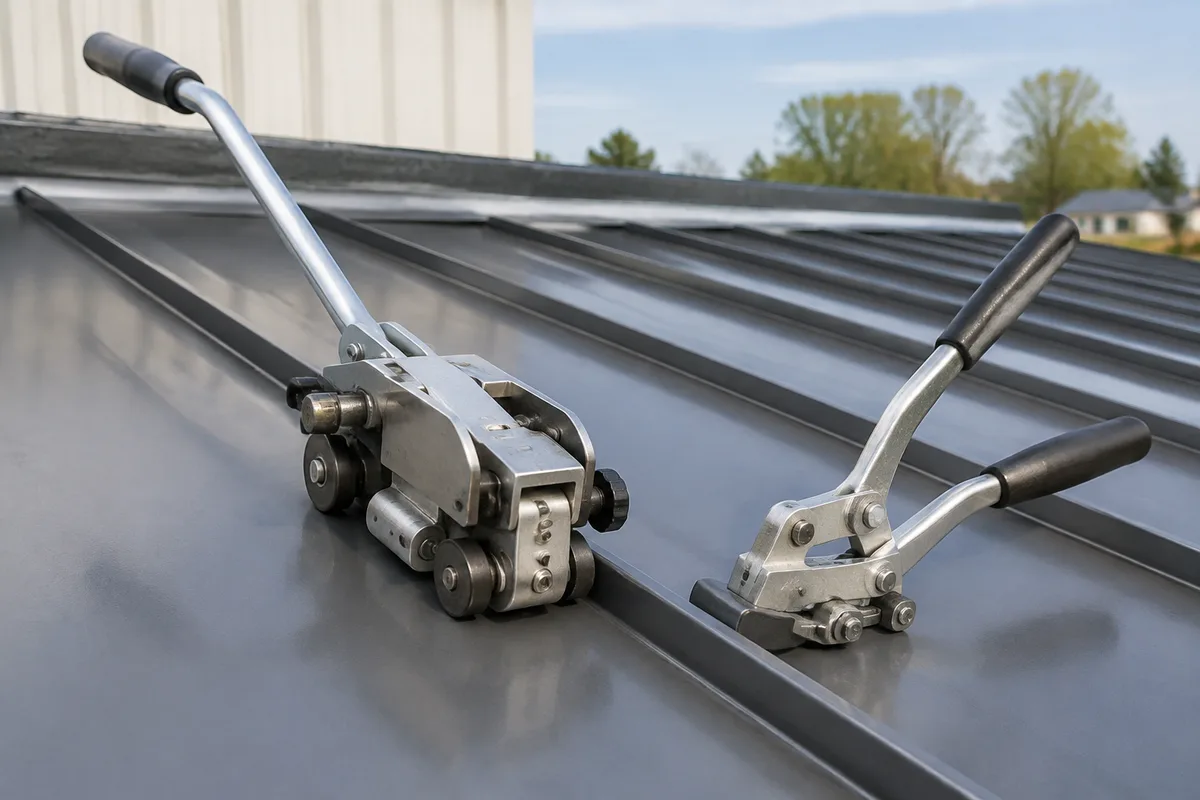
Mechanical & Hand Seamers
Mechanical and hand seamers are the tools that close a standing seam metal roof panel — folding and locking adjoining panel edges into a single tight seam. On a standing seam roof, the seam itself is what keeps wind, rain and uplift out, so how that seam gets formed matters as much as the metal itself.
What mechanical & Hand Seamers is
Standing seam metal roofing is built from long panels with raised edges that interlock along their length. A hand seamer is a hinged, plier-like tool used to fold and crimp short sections of panel edge by hand — at penetrations, corners, and tight details a machine cannot reach. A mechanical seamer is a motorized tool that rolls down the full length of a seam, folding both panel edges into a continuous, uniform lock in one pass.
Before mechanical seamers, crews closed seams entirely by hand with mallets and hand tools, which is slow and depends heavily on the installer's consistency from one seam to the next. Mechanical seaming closes each seam to a repeatable profile along its whole run, which is why most standing seam manufacturers specify a mechanically seamed lock for warranty coverage and wind uplift ratings, with hand seaming used to finish the sections a machine cannot travel.
How we use it at SoffitSmith by Smithbuilt Roofing
On standing seam metal roofing jobs, we lock panels down to the manufacturer's specification for wind uplift resistance, using mechanical seamers for the long field runs and hand seamers for eave ends, ridges, valleys and detail work. This pairs with the other metal tools we bring to a site — electric shears and nibblers for clean panel edges, portable sheet metal brakes for custom flashing and trim formed to fit the roof, and tin snips and hand seamers for the flashing details a brake or shear cannot handle.
Layout comes first: laser distance meters, levels and chalk lines set straight panel lines and correct pitch before any panel goes down. Fasteners and clips go in with cordless impact drivers, and the finished seams get checked before the crew moves on. This work sits alongside our other metal roofing capabilities and the fabrication we do on site for gutters and downspouts, so metal trim, flashing and drainage details are formed to match the roof rather than pieced together from stock parts.
What it means for you
A properly closed seam is what separates a standing seam roof that performs for the long haul from one that opens up at the edges in wind. Mechanical seaming gives a consistent lock profile down the full length of a panel run, so the seam strength does not depend on how tired an installer's hands are by the last panel of the day.
Hand seaming fills in where a machine cannot go — hips, valleys, ridge caps, penetrations — so the whole roof gets a properly formed seam, not just the easy runs. For you, that combination means a roof that is closed to spec everywhere, not only where it was convenient to close it well.
What to expect during your visit
Seaming happens as part of a standing seam metal roof installation, not as a stand-alone visit. Panels are measured, cut and laid out first; as each panel goes into place next to its neighbor, the mechanical seamer runs the length of the seam to fold and lock the edges. At transitions, corners and terminations, the crew switches to hand seamers to finish those sections by hand.
You will hear the mechanical seamer's motor running along the roof and see the crew working section by section rather than covering the whole roof at once. Access equipment such as scaffolding or lifts may be in place depending on the roof's height and pitch, and fall protection is used throughout. Timing depends on the size and complexity of the roof, since detail-heavy areas take longer to hand seam than open field runs.
Frequently asked questions
Is seaming a metal roof safe to be around?
Yes. The seaming equipment itself only engages the panel edges, and our crews work with fall protection — harnesses, lanyards and roof anchors — on any steep or elevated roof. You do not need to be on the roof or near it while the work is underway.
How long does seaming take?
It depends on the roof's size, pitch and number of details like valleys, hips and penetrations. Long, simple runs move quickly with a mechanical seamer; roofs with more corners, transitions and flashing details take longer because more of the seam has to be closed by hand.
Is standing seam with mechanical seaming suitable for any roof?
Standing seam metal roofing works on a wide range of roof shapes and pitches, and mechanical seaming is used on the runs long enough for the machine to travel, with hand seaming covering the rest. Whether it is the right roofing system for a particular home depends on the roof's design and the homeowner's goals.
Do I need to prepare anything before this work starts?
No special preparation is needed beyond clearing access around the house if requested. Landscape protection tarps are used to cover beds, walks and plantings before work begins, and the crew keeps the site clear of loose material and fasteners as the work proceeds.
If you are considering a standing seam metal roof or have questions about how panels are seamed and locked down, reach out to SoffitSmith by Smithbuilt Roofing and we will be glad to walk you through it.