Hot-Air Welders for TPO & PVC
Hot-Air Welders for TPO & PVC
Single-ply roofing systems like TPO and PVC are only as good as their seams. A membrane can be the right material, cut and laid correctly, and still fail early if the seams are not fused properly. Hot-air welding is the method that joins those sheets into one continuous, watertight surface, and it is a core part of how we install and repair single-ply roofs at SoffitSmith by Smithbuilt Roofing in Bradenton.
What hot-Air Welders for TPO & PVC is
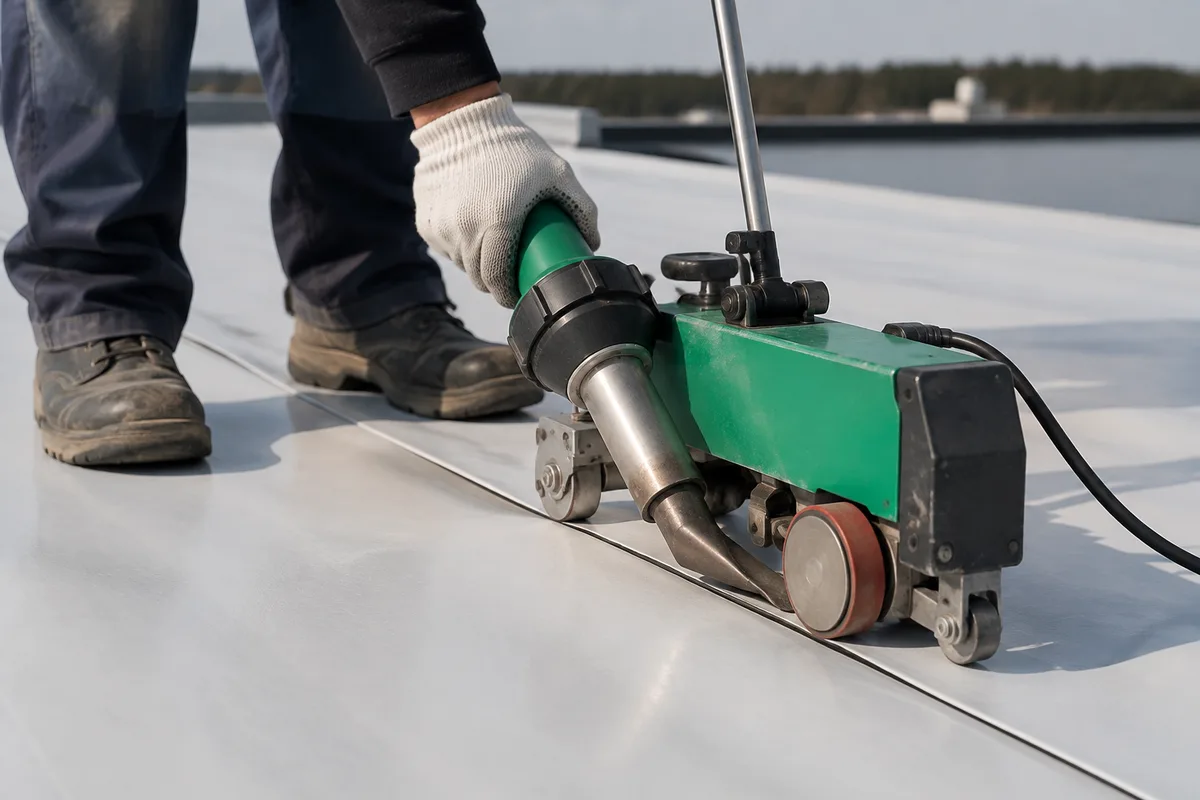
A hot-air welder heats the overlapping edges of two membrane sheets to the precise temperature needed to melt the top layer of each without scorching or thinning the material underneath. Once heated, the seam is pressed together, either by hand with a roller or automatically by a machine that heats and rolls in a single pass, fusing the two sheets into one solid piece of membrane.
This is different from older adhesive- or solvent-based seaming methods, which relied on glues and tapes that could dry out, lift, or fail at the edges over time. A properly hot-air welded seam is not a bonded joint sitting on top of the membrane — it becomes part of the membrane itself, which is why it is the standard method for TPO and PVC roofing today.
Crews typically use two types of welders on the same job: handheld units for detail work around penetrations, corners, and flashing, and automatic walk-behind welders for long, straight seam runs on open field areas of the roof.
How we use it at SoffitSmith by Smithbuilt Roofing
We use handheld and automatic hot-air welders to fuse single-ply membrane seams into a continuous watertight sheet, whether we are installing a new TPO or PVC roof, converting an existing roof to a single-ply system, or repairing a seam that has opened up on a flat or low-slope roof.
Welding is only one step in how we finish a flat roof. Membrane is fastened to the deck with our membrane fastening tools and stand-up screw guns in a consistent pattern before seams are welded, and every welded seam is then checked with our seam rollers and probes by hand before we consider that section finished. On repair calls, we may also use core sampling tools and moisture meters first, to confirm whether a seam failure is an isolated issue or a sign of wet insulation underneath that needs to be addressed before we reseal anything. We document the work with our photo documentation app as it progresses, so you can see the same seam-by-seam record we do.
What it means for you
A hot-air welded seam does not rely on an adhesive that can degrade with age and sun exposure, which is one reason single-ply systems are common on flat and low-slope roofs where standing water and ponding put extra stress on every seam. Because the seam becomes part of the membrane, there is no separate glue line to check on later — the weld either holds or it does not, and it can be probed and verified on the spot.
For a homeowner or property owner, the practical benefit is a flat roof where the weak point — the seam — is treated as carefully as the field of the membrane itself. Welding also tends to be faster to complete correctly than solvent seaming, which can mean less time with equipment and materials staged on your roof or property.
What to expect during your visit
On an installation or roof-over, welding happens after the membrane is rolled out, positioned, and mechanically fastened to the deck. You will hear the low hum of the automatic welder as it moves along field seams, and you may see a crew member with a handheld unit working detail areas around drains, vents, and edges by hand. On a repair visit, the process is shorter: the damaged or open seam is cleaned, reheated, and re-welded, then checked.
Weather matters for this work. Hot-air welding needs a dry membrane surface, so we plan around rain and heavy dew. Once conditions are right, welding a typical residential or small commercial flat roof section is a same-day task; every seam is rolled and probed before we consider the area complete, and any seam that does not pass is reheated and rewelded on the spot rather than left as-is.
Frequently asked questions
Is hot-air welding safe for the rest of my roof and property?
Yes. The welder is set to heat only the top layer of the membrane at the seam, and the equipment is controlled and directed by hand or by a guided machine, not left running unattended. We also use landscape protection tarps to keep beds, walks, and plantings clear during roofing work.
Will welding work disrupt my household or business?
Most of the noise is a steady hum from the automatic welder, similar to other roofing tools, and the work stays on the roof itself. There is no strong odor associated with hot-air welding, which is one advantage over older solvent-based seaming methods.
How long does welding take on a typical flat roof?
It depends on the size of the roof and the amount of detail work around penetrations and edges. Straight field seams go quickly with the automatic welder; corners, drains, and flashing take longer because they are welded by hand. Every seam is checked before the crew moves on, which is part of the total time on site.
Is this method suitable for any single-ply roof?
Hot-air welding is the standard fusing method for TPO and PVC membranes specifically, since both materials are formulated to melt and re-bond under controlled heat. It is not used on every roofing material — modified bitumen and other systems are joined by different methods suited to what they are made of.
If you have a TPO or PVC roof that needs a seam repair, or you are considering a single-ply system for a new or existing roof, reach out to SoffitSmith by Smithbuilt Roofing to talk through what hot-air welding would look like on your project.