Hook Blade Utility Knives
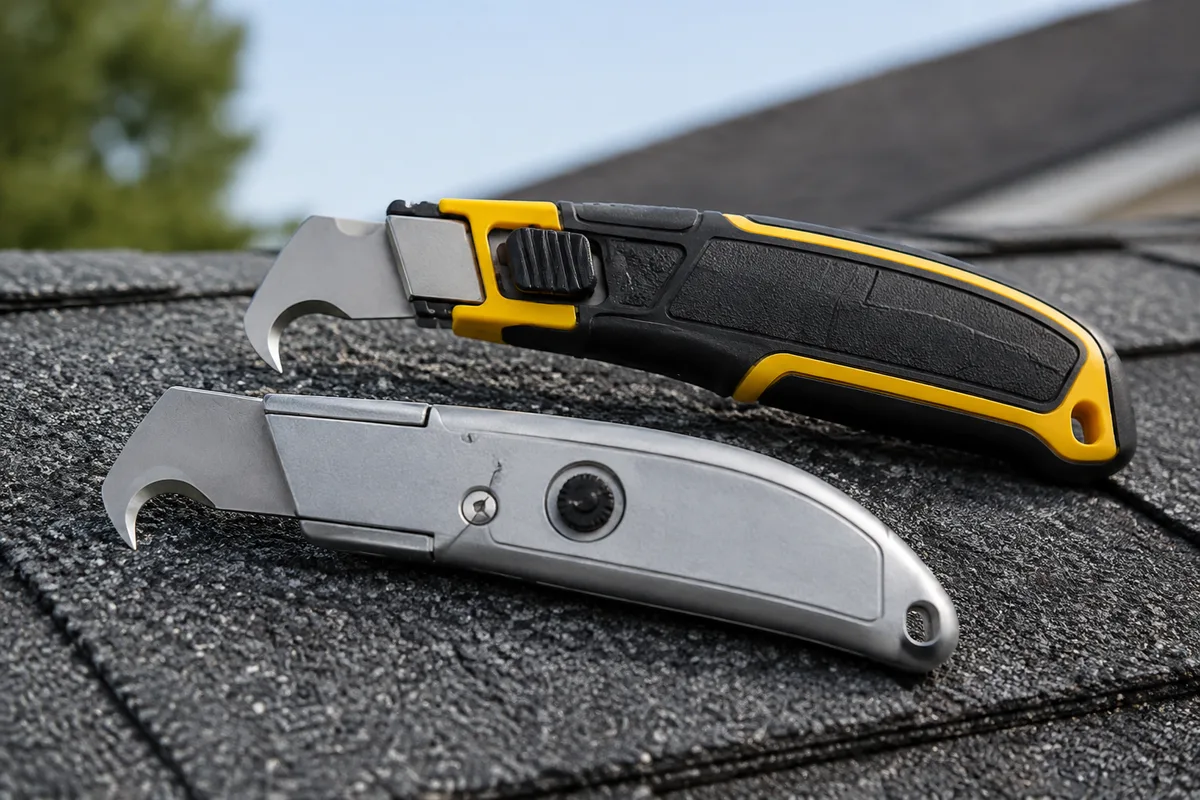
Hook Blade Utility Knives
A hook blade utility knife is one of the simplest tools on a roof crew's belt, and one of the most important. It is used for precise, controlled cuts through shingles, underlayment, and single-ply membrane wherever a straight, clean edge matters more than speed. At SoffitSmith by Smithbuilt Roofing, this hand tool works alongside larger power equipment to handle the detail cuts that a saw or shear cannot make safely.
What hook Blade Utility Knives is
The hook blade utility knife takes its name from the curved, hook-shaped cutting edge set into a standard utility knife handle. Instead of a straight blade that can dig downward into whatever is beneath the material being cut, the hook rides along the top surface and pulls through it in a controlled slicing motion. This design lets a roofer follow a chalk line or existing course edge through asphalt shingles, synthetic underlayment, or single-ply membrane without the blade tip catching or plunging into the layer underneath.
Before hook blades were standard, crews often relied on straight utility blades for the same cuts. A straight blade does the job on thin material, but on thicker shingles or membrane it is easy to score, nick, or fully cut through the decking, felt, or membrane sheet below the piece being trimmed. The hook geometry solves that problem by design rather than by extra care alone, which is part of why it became the standard hand tool for this kind of work.
How we use it at SoffitSmith by Smithbuilt Roofing
On shingle work, hook blade utility knives are used for trimming courses along valleys, hips, and rake edges, and for scoring shingles to length without damaging the underlayment beneath them. On low-slope and flat-roof jobs, the same tool is used for detail cuts in TPO, EPDM, and PVC membrane around penetrations, drains, and terminations, where our hot-air welders then fuse the trimmed edges into a continuous, watertight seam.
These knives work alongside the other cutting tools on our trucks rather than replacing them. Electric shears and nibblers, tin snips and hand seamers, and circular saws and angle grinders handle the larger or metal cuts, while hook blades take over for the fine, close-quarters trimming that those tools are not built for. Roofing shovels, tear-off spades, and pry bars clear the old material first, and the hook blade comes in during installation and detail work, where a clean cut against an existing surface actually matters.
What it means for you
A clean cut matters more than it might seem. A gouged or torn underlayment layer can create a weak point long before the shingles above it show any sign of a problem, and a nicked membrane sheet is a seam that has to be re-welded or patched rather than left as-is. Using the right blade for the material reduces the chance of that kind of hidden damage happening in the first place.
For homeowners, this shows up mostly in the quality of the finished edges: shingle courses that line up evenly along valleys and rakes, and membrane details that sit flat and welded rather than patched. It is not a visible feature of the finished roof so much as a reason the visible features turn out the way they should.
What to expect during your visit
On a shingle or membrane job, hand-cutting with a hook blade happens throughout the installation, not as a separate step. During tear-off and layout, our crew uses laser distance meters, levels, and chalk lines to mark courses and cut lines. As shingles or membrane sheets are set, the hook blade is used to trim them to that line, and on membrane work those trimmed edges are then welded and later rolled and probed to confirm the seam is sealed.
You will not typically see this tool called out as its own line item on an invoice or schedule. It is part of the general installation and repair process, used as often as the material and the cut in front of the crew requires it, which on a full roof can be dozens of times over the course of a day.
Frequently asked questions
Is a hook blade utility knife safe to use around my home?
Yes. It is a small, controlled hand tool used by trained crew members, and its curved design is specifically meant to reduce the chance of the blade catching or slipping into material it should not cut. Our crews also use fall protection and stable footing equipment on the roof itself, separate from the cutting tools they carry.
Will this tool damage my existing roof layers?
The hook shape is built to prevent that. Because the blade rides along the surface being cut instead of angling downward, it is far less likely to score or puncture the underlayment, decking, or membrane sitting underneath the material being trimmed, compared with a straight utility blade.
How often is it used during a job?
On shingle and membrane installations or repairs, it is used regularly throughout the work, wherever a course, sheet, or flashing detail needs to be trimmed to fit. It is a standard part of the process rather than a specialty step scheduled on its own.
Is this tool used on every type of roof?
It is most relevant to asphalt shingle, synthetic underlayment, and single-ply membrane work such as TPO, EPDM, and PVC. Metal roofing and other rigid materials generally call for shears, snips, or seamers instead, which our crews also carry.
If you have a shingle repair, replacement, or flat-roof membrane project coming up, get in touch with SoffitSmith by Smithbuilt Roofing to ask how our crews approach the detail work on your roof.