Gutter Crimpers, Outlet Punches & Rivet Guns
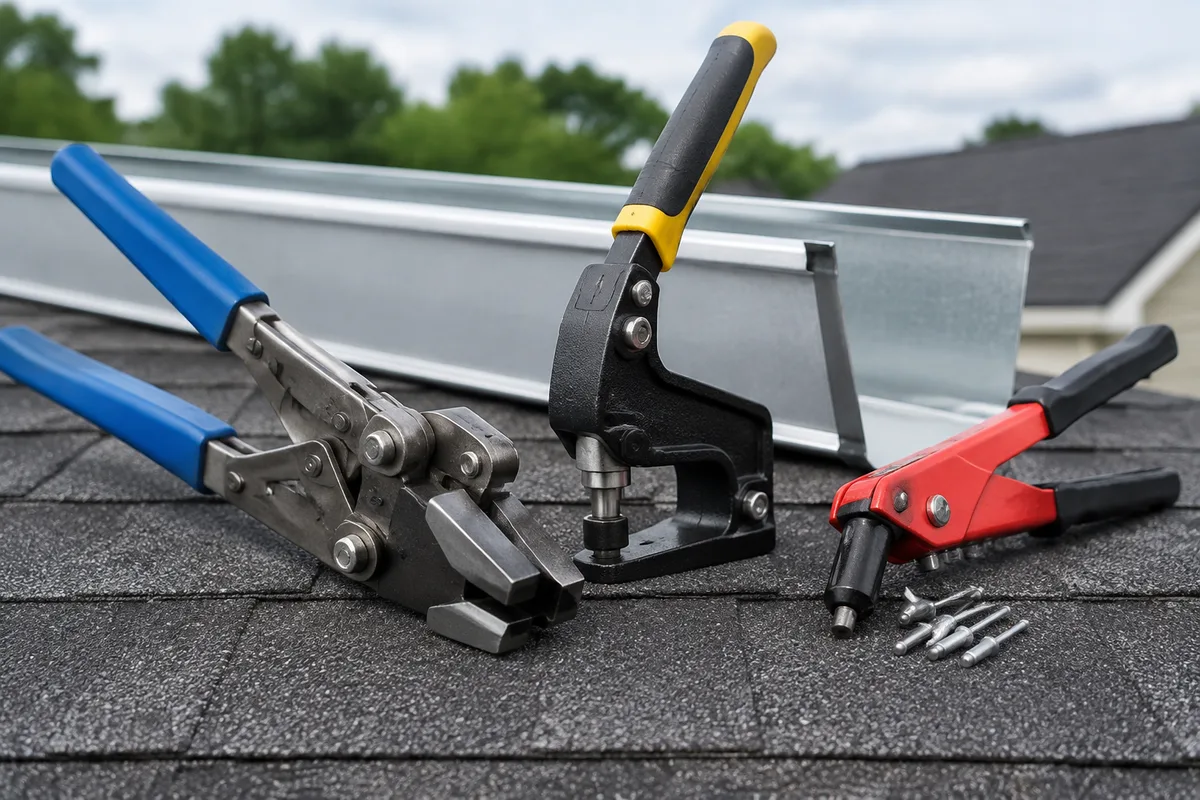
Gutter Crimpers, Outlet Punches & Rivet Guns
When a gutter run turns a corner, drops into an outlet, or needs a downspout attached, the joint has to be formed and fastened correctly the first time. Gutter crimpers, outlet punches and rivet guns are the hand tools that make that possible on site, shaping metal into tight, secure connections instead of relying on caulk alone to hold a seam together.
What gutter Crimpers, Outlet Punches & Rivet Guns is
A gutter crimper is a hand tool that folds and compresses the end of a gutter section so it nests into the next piece without leaving a gap for water to find. An outlet punch cuts a clean, correctly sized opening in the gutter bottom where a downspout connects, instead of an uneven hole cut freehand. A rivet gun then sets metal rivets through overlapping joints, corners and outlet fittings, pulling the pieces together with a fastener that will not back out the way some screws or nails eventually do.
Before tools like these were standard, gutter joints were often held together with sealant and hope, or with fasteners that left a rougher edge prone to catching debris and rusting through. Crimping, punching and riveting give a mechanical connection first, with sealant reinforcing that connection rather than doing all the work.
How we use it at SoffitSmith by Smithbuilt Roofing
These tools come into play right after gutter is formed. Our trailer-mounted seamless gutter machine rolls gutter stock into one continuous length cut to your roofline on site, which already removes most of the seams a leak could start at. Where a run still needs a corner, an end cap, or a downspout outlet, the crimper, punch and rivet gun finish that connection so it is formed tight and fastened correctly rather than patched together.
Downspouts formed with our downspout roll-former are set into those punched outlets, and hidden hanger tools go in afterward to hang the finished run on concealed hangers so the fascia line stays clean. The result, as the practice puts it, is tight, correctly formed gutter joints, outlets and miters that do not leak at the corners.
What it means for you
A gutter system is only as good as its weakest joint, so the corners, outlets and downspout connections matter as much as the straight runs between them. Well-formed joints resist the kind of slow separation that shows up years later as a drip line down the siding or a soft spot in the fascia behind the gutter.
- Fewer weak points — mechanically formed and riveted joints hold their shape under the weight of water and debris better than a joint relying on sealant alone.
- Cleaner appearance — a properly punched outlet and a tight miter look intentional, not patched.
- Less maintenance later — a joint that does not shift or gap is one less thing to inspect every season.
What to expect during your visit
On a gutter installation or replacement visit, the roofline is measured first, then gutter stock is rolled to length on site. As sections come off the machine, corners, end caps and downspout outlets are shaped and punched to fit the specific run on your house rather than a standard size. Rivet guns set the fasteners at each of those connection points, and hidden hangers go in as the run is set in place. For a repair visit, the process is shorter: a failing joint or outlet is opened up, reformed or re-punched, and riveted back together. Most of this work happens from a ladder or lift at the fascia line, so it is quick and does not require access inside the home.
Frequently asked questions
Is crimping and riveting gutter safe for my roof and siding?
Yes. The work is done on the gutter and fascia line itself, using hand tools that shape and fasten metal without cutting into roofing material or siding. Any nearby landscaping or surfaces can be protected with tarps if the job calls for it.
How long does it take to form and rivet a gutter joint?
Forming a single joint, outlet or corner takes only a few minutes once the gutter section is in place. The overall timeline depends on the length of the run and how many corners, outlets and downspout connections the roofline requires.
Will I hear this work happening?
There is some tapping and mechanical noise from crimping and riveting, similar to other hand-tool work at the fascia line. It is brief and limited to the sections being formed, not continuous through the whole visit.
Is this suitable for any type of gutter system?
Crimpers, outlet punches and rivet guns are used on standard seamless metal gutter systems formed on site, matched to the downspouts and hangers used on the same job. They are part of standard gutter installation and repair work rather than a separate add-on.
If you are having gutter installed, replaced or repaired and want joints and outlets that hold up at the corners, get in touch with SoffitSmith by Smithbuilt Roofing to talk through what your roofline needs.