Full-Body Harnesses, Lanyards & Roof Anchors
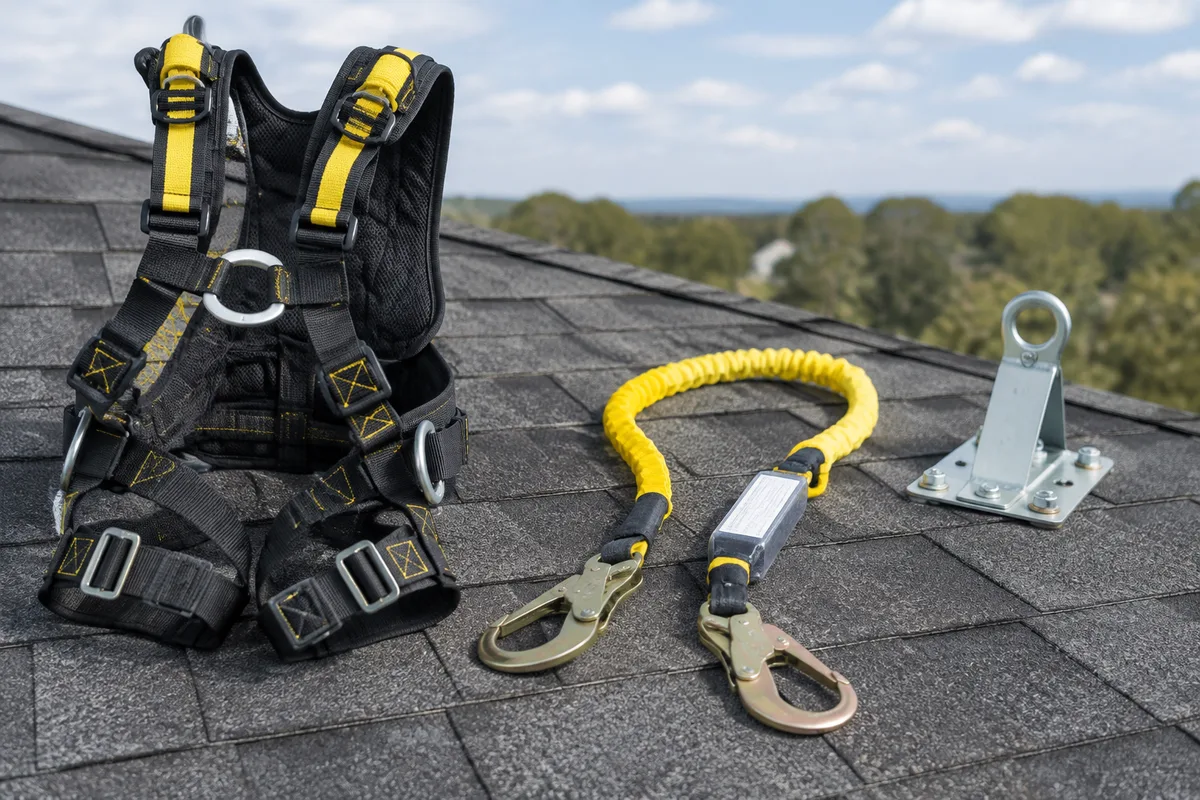
Full-Body Harnesses, Lanyards & Roof Anchors
Any time work happens on a steep slope or a roof edge, fall protection has to be in place before the first tool comes out. Full-body harnesses, lanyards and roof anchors are the equipment that makes that possible — they keep a worker tied to the roof structure rather than relying on footing alone. This page walks through what the gear is, how it fits into a typical roofing visit, and what it means for you as a homeowner.
What full-Body Harnesses, Lanyards & Roof Anchors is
A full-body harness is a webbing system worn over the shoulders, chest, and legs that distributes the force of a fall across the body instead of a single point. It connects through a lanyard — a length of rope or webbing with shock-absorbing capability — to a roof anchor, which is a fixed point secured into the structural framing of the roof itself. Together they form a tied-off system: if footing is lost, the worker is caught before reaching the edge or the ground.
This approach replaced older habits of relying only on ladders, rope grips, or simple body belts, none of which properly arrest a fall or distribute the load safely. Modern anchors are rated for the loads involved and are placed and removed as part of the job, with the resulting penetration sealed so it does not become a future leak point.
How we use it at SoffitSmith by Smithbuilt Roofing
SoffitSmith by Smithbuilt Roofing puts full-body harnesses, lanyards and roof anchors to work on every steep or elevated job, both to protect our crew and to reduce liability exposure on your property. This gear is one part of a broader access setup that typically also includes scaffolding, boom or scissor lifts, extension ladders with stabilizers, and roof jacks, toe boards and planks — each chosen based on the slope, height, and layout of the specific roof.
Fall protection is set up before any tear-off, repair, or installation work begins, whether the job is a full roof replacement, new construction roofing, metal or tile work, or a structural or roof deck repair. Anchor points are placed according to the roof framing, used through the work, and removed with the penetration properly sealed once the job is finished.
What it means for you
For a homeowner, the presence of proper fall protection is a sign that a crew is working methodically rather than rushing across a roof surface. It generally means fewer interruptions, since a properly tied-off crew can move confidently across a steep slope without stopping to reposition ladders or improvise footing.
It also tends to mean a cleaner job site. Anchors are placed with intention, work proceeds at a steady pace section by section, and there is no need for makeshift supports that could damage shingles, gutters, or landscaping below.
What to expect during your visit
Before work starts, the crew will walk the roof to identify anchor points based on the framing below, matching the setup to the pitch and height of your specific roof. You may see anchors being set near the ridge or other structural points, with harnesses and lanyards clipped in before anyone moves onto the slope.
During the job, the fall protection stays in place for the duration of any work at height — this is standard for steep-slope tear-off, installation, or repair work and does not add meaningfully to the schedule since it is part of normal setup and teardown. Once the work is complete, anchor points are removed and any penetration in the roof deck is sealed as part of finishing the job, so nothing is left behind that could compromise the roof.
Frequently asked questions
Is fall protection used on every roof, or just steep ones?
It is used on every steep or elevated job, since the risk of a fall exists any time a crew is working above ground level on a sloped surface. Lower-slope or single-story sections may call for a different mix of access equipment, but harnesses, lanyards, and anchors are part of the standard setup whenever the roof pitch or height calls for it.
Will the anchor points leave holes in my roof?
Anchors are secured into the structural framing, which does create a penetration point, but it is sealed properly once the anchor is removed at the end of the job. This is a routine part of finishing steep-slope work and is handled before the crew leaves the site.
Does using fall protection slow down the job?
Setting up harnesses and anchors happens at the start of the work and is part of the normal preparation, similar to setting up ladders or lifts. It is not an added step so much as a standard part of how any steep or elevated roofing job is approached from the beginning.
Is this relevant to me if I just need a small repair?
Yes — fall protection applies to any work at height, whether it is a full roof replacement or a smaller repair like a flashing fix or a deck rot section. If the work requires being on a steep or elevated section of roof, the same tied-off approach applies.
If you have a project that involves steep or elevated roof work, reach out to SoffitSmith by Smithbuilt Roofing to talk through how fall protection fits into your job.