Extension Ladders with Stabilizers
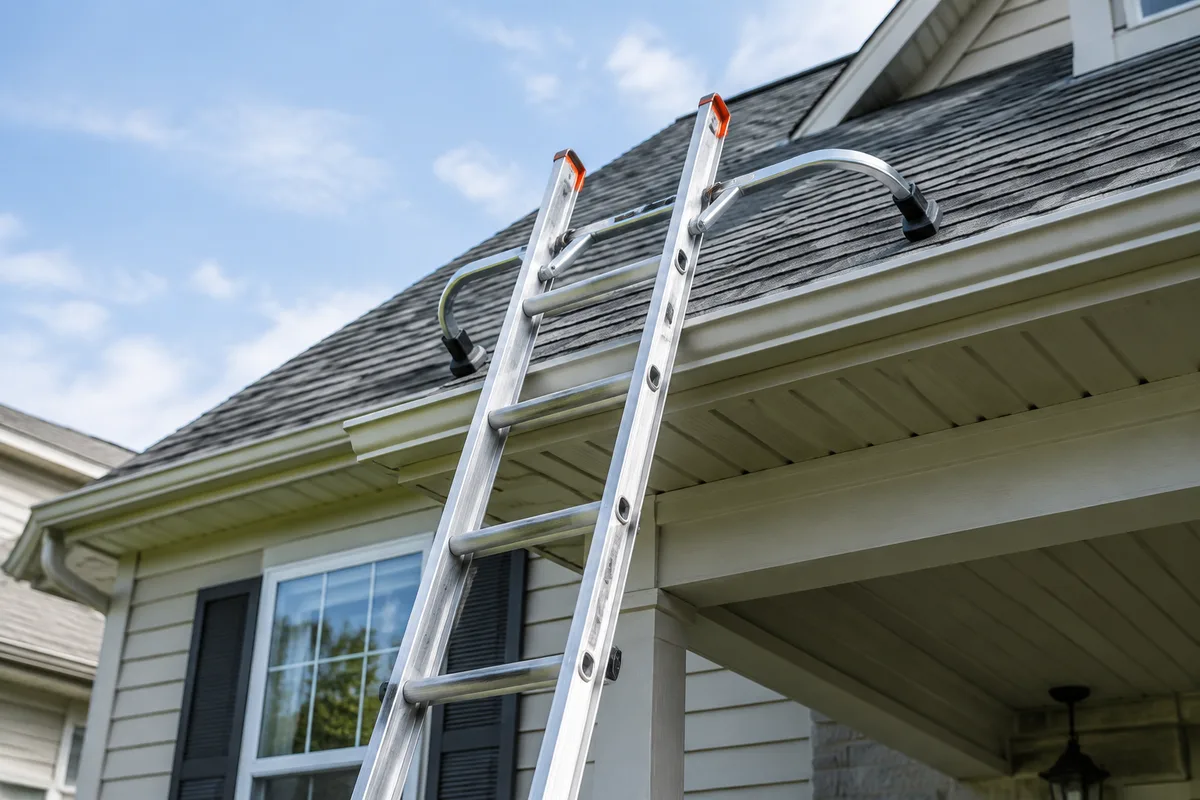
Extension Ladders with Stabilizers
Getting a crew and their tools safely onto a roof is the first job of every inspection, repair, or replacement. At SoffitSmith by Smithbuilt Roofing, extension ladders fitted with stabilizer bars are one of the ways we set up that access on a typical Bradenton property, keeping the ladder steady and off your gutters while our team moves up and down through the day.
What extension Ladders with Stabilizers is
An extension ladder with a stabilizer is a standard extension ladder fitted with a wide standoff bar at the top. Instead of the ladder's rails resting directly against a fascia board or gutter, the stabilizer spans out and contacts the wall or roof edge at two or more points, spreading the load and holding the ladder away from soft or narrow surfaces.
This setup improves on a plain ladder leaned straight against the eave in a few ways. It reduces the chance of the top of the ladder slipping sideways, keeps the rails from resting on and bending gutter material, and gives a wider, more level base of contact on uneven walls, stucco, or trim. It does not replace fall protection or lifts for taller or steeper work — it is one tool in an access plan that also includes harnesses, planks, and mechanical lifts depending on the roof.
How we use it at SoffitSmith by Smithbuilt Roofing
On most single-story and many two-story homes, a stabilized extension ladder is how our crew first gets up to look at a roof, carry tools, or begin a tear-off. The stabilizer bar means we are not resting a ladder's rails directly on your gutter runs, which matters on a roof where we may also be installing or repairing seamless gutter formed on site.
Ladder access typically works alongside other equipment already in the truck: Ladder Hoists & Shingle Conveyors to lift material instead of hand-carrying it up the ladder, Full-Body Harnesses, Lanyards & Roof Anchors once the crew is on a steep or elevated surface, and Roof Jacks, Toe Boards & Planks for secure footing once work begins. For taller commercial buildings or roofs that call for a wider, more stable platform, we bring in Scaffolding & Boom/Scissor Lifts instead. Our service vans and pickups carry ladder racks, so a repair or inspection crew generally arrives with the right ladder and stabilizer already on the truck.
What it means for you
A stabilized ladder set-up is mainly about protecting your property and keeping access predictable. Because the stabilizer holds the ladder off the gutter and wall surface, there is less risk of dented gutters, scuffed siding, or crushed plantings directly under the ladder's feet. A wider, steadier base also means the crew can reposition the ladder around the house without repeated re-leaning against different points of the fascia.
For you as the homeowner, this generally translates into a calmer visit: less noise and repositioning near windows and doors, fewer marks to notice afterward, and a crew that can move between access points efficiently rather than fighting an unstable ladder. It is a small piece of equipment, but it affects how much disturbance a roof visit brings to the rest of the property.
What to expect during your visit
Before anyone climbs, the crew walks the property to pick solid, level ground for the ladder's feet and to identify where a stabilizer bar can rest against the fascia or wall without landing on a downspout, vent, or light fixture. Landscape Protection Tarps may go down first if beds or plantings sit directly below the chosen access point.
During the visit, you may see the ladder repositioned a few times as work moves from one section of the roof to another, especially on larger homes. Setup and adjustment for each position typically takes only a few minutes, and the ladder itself is a small part of a longer inspection, repair, or installation. Once the crew is done for the day, the ladder comes down, and the ground beneath it gets a quick check along with the rest of the site.
Frequently asked questions
Is a stabilized ladder safe to use on my roof?
Stabilizer bars are designed to widen the ladder's contact points and reduce side-to-side movement, which is why they are a standard piece of access equipment for roofing work. For steeper or taller sections, our crews pair ladder access with harnesses, anchors, or a lift rather than relying on the ladder alone.
Will the ladder damage my gutters or siding?
The stabilizer's purpose is to keep the ladder's rails off the gutter edge and spread contact across a wider point on the fascia or wall, which is intended to reduce marking or bending compared with a plain ladder leaned directly on those surfaces.
How long does the ladder stay up during a visit?
It depends on the job. For an inspection, the ladder may go up and down within a short window; for a repair or replacement, it can be repositioned multiple times over the course of the day as the crew works across the roof.
Is this the right access method for every roof?
It works well for many single- and two-story homes, but taller, steeper, or larger commercial roofs may call for scaffolding or lift access instead. Our crews choose the access method based on the roof in front of them.
If you have a roof visit coming up and want to know how we plan access around your gutters, landscaping, or a taller section of your home, get in touch with SoffitSmith by Smithbuilt Roofing and we can walk through it with you.