Downspout Roll-Former
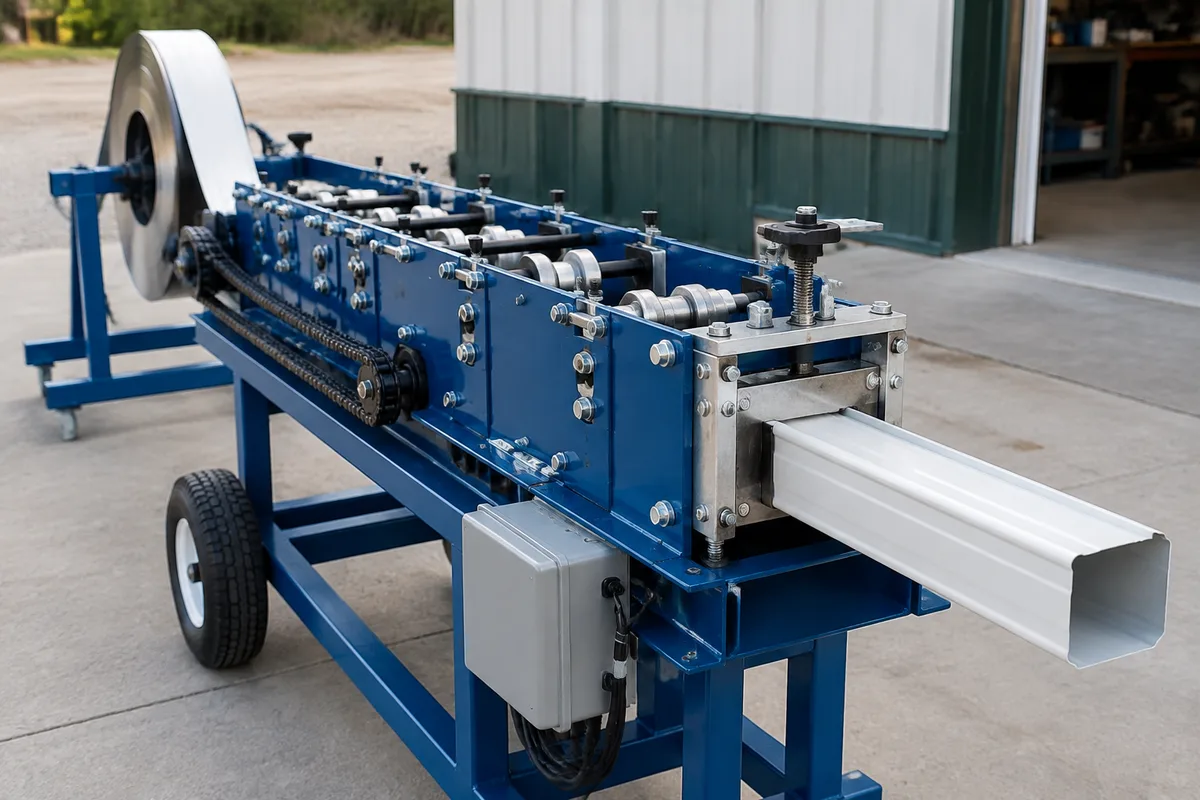
Downspout Roll-Former
A downspout roll-former is the equipment that takes flat sheet metal and shapes it into finished downspout, right at your house, cut to the exact length your gutter run needs. Instead of arriving with pre-cut stock in a handful of standard sizes, a crew forms the piece on site so the drop lines up with the gutter above it and the wall or corner it runs down.
What downspout Roll-Former is
Downspout has traditionally come in fixed lengths that get cut, pieced, and sometimes forced to fit a run they were not made for. A roll-former changes that by feeding flat metal through a set of rollers that progressively bend it into the finished downspout profile, producing a piece formed to the actual measurement of the job rather than the nearest stock size.
Because the metal is shaped in one continuous pass, the resulting downspout has consistent dimensions along its whole length, which matters when it has to connect cleanly to an outlet at the top and a splash block, extension, or drainage tie-in at the bottom. This is the same basic principle behind on-site seamless gutter forming, applied to the vertical piece that carries water away from the gutter.
How we use it at SoffitSmith by Smithbuilt Roofing
On a gutter or downspout job, our crews use the roll-former alongside the trailer-mounted seamless gutter machine, forming the gutter run and the matching downspout drops on site so the two pieces are sized to each other and to your house rather than assembled from generic parts. Downspout formed to length reduces the number of joints needed to reach the ground, which is part of what keeps a downspout looking straight against the wall instead of stepped or offset.
Downspout work is typically finished with gutter crimpers, outlet punches, and rivet guns to form tight connections at the outlets and elbows, and with hidden hanger tools where the run needs to be secured cleanly along the fascia. This equipment supports the broader gutter and downspout work we do, including seamless gutter fabrication, gutter installation and replacement, and downspout installation and extension.
What it means for you
Downspout formed to the exact length of your drop means fewer field cuts and fewer joints, which generally translates into a cleaner line down the side of the house and fewer places where a seam could eventually work loose. Matching the downspout to the gutter run on site also means the size and profile are consistent from the outlet at the top to the discharge point at the bottom.
Homeowners often notice that on-site forming shortens the time spent waiting on special-order lengths, since the material is shaped to fit rather than selected from stock and adjusted. It also means the downspout is sized to your specific roofline rather than to a standard length that happens to be close.
What to expect during your visit
Before any metal is formed, the crew measures the drop from the gutter outlet to the ground or discharge point, noting any offsets around windows, trim, or corners the downspout needs to clear. The roll-former is typically set up on a trailer near the work area, and the downspout is fed through and cut to the measured length rather than assembled from shorter pre-cut sections.
Once formed, the downspout is fitted to the outlet, secured with hidden hangers or straps along its run, and connected at the base to whatever the drainage plan calls for, whether that is a simple splash block or a connection into a larger drainage or extension system. Forming and installing downspout is usually a straightforward part of a gutter visit rather than a separate, lengthy process on its own, and it is commonly done in the same visit as the gutter itself.
Frequently asked questions
Is on-site downspout forming disruptive or noisy?
The roll-former runs on a trailer set up near the work area, and forming a length of downspout takes only a few minutes per section. It is no louder than other roofing equipment used during a typical exterior visit, and the process does not require access inside the house.
How long does it take to form and install downspout?
Forming the downspout itself is quick once measurements are taken; the overall time depends on how many drops your home needs and whether it is done alongside a full gutter installation. In most cases downspout work is completed in the same visit as the gutter run it serves.
Is on-site forming suitable for any house?
Yes. Because the downspout is formed to the measured length of each specific drop, it adapts to different wall heights, offsets, and roofline shapes rather than depending on a standard stock size fitting your home.
Does this affect how the downspout connects to my drainage system?
No, a properly formed downspout still connects the same way to splash blocks, extensions, or existing drainage tie-ins. The forming step simply determines the length and fit of the piece itself before those connections are made.
If you are planning new gutters, replacing old downspout, or just want drops that actually match your roofline, reach out to SoffitSmith by Smithbuilt Roofing to talk through what on-site forming can do for your home.