Cordless Impact Drivers & Framing Nailers
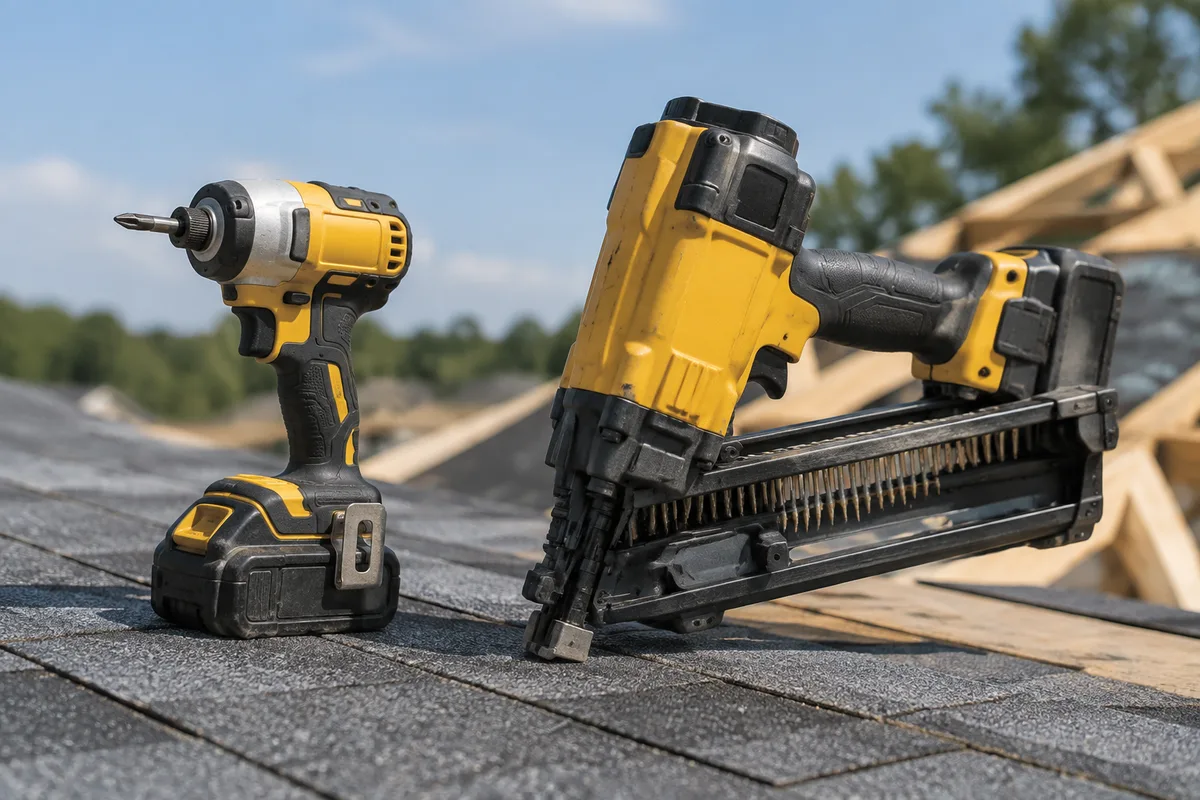
Cordless Impact Drivers & Framing Nailers
Cordless impact drivers and framing nailers are the fastening tools behind almost every stage of a roofing job that touches wood — decking, framing, structural repairs, and the trim and blocking that hold a roof system together. On their own they are not glamorous, but the speed and consistency they bring to fastening decking and framing members has a direct bearing on how sound the finished roof is.
What cordless Impact Drivers & Framing Nailers is
A cordless impact driver delivers rotational torque in rapid bursts, which lets it drive screws and structural fasteners into wood without stripping the fastener head or bogging down partway through — something a standard drill struggles with on dense or engineered lumber. A framing nailer does a related job with a different mechanism: it drives full-size nails through decking, rafters, and framing members in a single motion, at consistent depth, using either pneumatic pressure or a self-contained battery-and-fuel system.
Both tools replaced slower, more variable hand-fastening methods. Hand-driven nails and screws depend on the arm swinging the hammer or the wrist turning the screwdriver, so depth and spacing tend to drift over a long run. Cordless and pneumatic fastening tools hold that depth and spacing steady from the first fastener to the last, which matters most on framing and decking, where an under-driven or over-driven fastener can leave a soft spot or a raised head under the roofing material that goes down next.
How we use it at SoffitSmith by Smithbuilt Roofing
On a Smithbuilt job, cordless impact drivers and framing nailers come out whenever decking, framing, or structural repair is part of the scope — rebuilding a soft section of deck, sistering a rafter, or fastening new blocking before flashing and covering go on. Fast, consistent fastening at this stage sets up everything that follows: pneumatic coil roofing nailers for the shingles themselves, cap nailers for the underlayment, and the sheet metal and flashing work that seals it all against the weather.
These tools work alongside the rest of the framing and demolition kit already on site. Framing squares and layout tools mark where new lumber goes before a single fastener is driven; pry bars and nail pullers clear old fasteners so replacement decking sits flat; and where the job calls for cutting rather than fastening, reciprocating saws and circular saws handle the framing and decking work in between. A towable air compressor supplies steady air for pneumatic tools on jobs without usable power, and magnetic nail sweepers pass over the yard and drive at the end of the visit to collect stray fasteners before the crew leaves.
What it means for you
For a homeowner, the practical benefit of cordless and pneumatic fastening tools is a repair or replacement that goes together with fewer surprises. Fasteners driven to a consistent depth mean the deck or framing underneath your new roofing lies flat, without high nail heads that can telegraph through shingles or membrane over time. Battery-powered and pneumatic tools also mean less noise variability and no cord to trip a hazard around, which keeps the work area a bit safer for everyone on site.
Because these tools move quickly, the structural portion of a repair or replacement — the part that has to happen before anything else can go on the roof — tends not to be the part that stretches a project out. That leaves more of the visit for the careful layout and flashing work that actually protects the structure long-term.
What to expect during your visit
If your project includes deck or framing repair, that work happens early in the visit, usually right after tear-off or removal of the damaged section. You will likely hear the intermittent pop of a framing nailer or the shorter bursts of an impact driver as new lumber and decking go in — it is a normal, expected sound during this stage, not a sign of a problem. Depending on the extent of the repair, this portion of the work might take anywhere from under an hour for a small section to most of a day on a larger structural repair; your crew can give you a more specific sense once they see the deck.
Once fastening is complete, the crew moves on to underlayment, flashing, and the covering material itself. Before they leave for the day, expect a walk of the work area with magnetic nail sweepers to pick up stray fasteners from the yard, drive, and beds.
Frequently asked questions
Is fastening work with these tools safe for the rest of my property?
Yes. The crew works from stable footing using standard fall protection and access equipment, and fastener clean-up with magnetic sweepers happens at the end of the visit to keep the yard and driveway clear.
How long does the fastening portion of a repair take?
It depends entirely on how much decking or framing needs replacing. A small soft spot might be fastened in well under an hour, while a larger structural repair takes longer; this stage happens before flashing and covering materials go on.
Will I hear a lot of noise during this part of the job?
You will hear intermittent nailing and driving sounds while decking and framing are fastened. It is normal, short-lived compared to the full length of a project, and stops once the crew moves on to underlayment and covering work.
Is this kind of fastening suitable for any roof type?
Cordless impact drivers and framing nailers apply to any roof with wood decking or framing that needs repair or replacement, regardless of what covering material — shingle, tile, metal, or membrane — ultimately goes on top.
If you would like to talk through a decking, framing, or structural repair on your roof, reach out to SoffitSmith by Smithbuilt Roofing and we can walk you through what your project would involve.