Chainsaws & Pole Saws
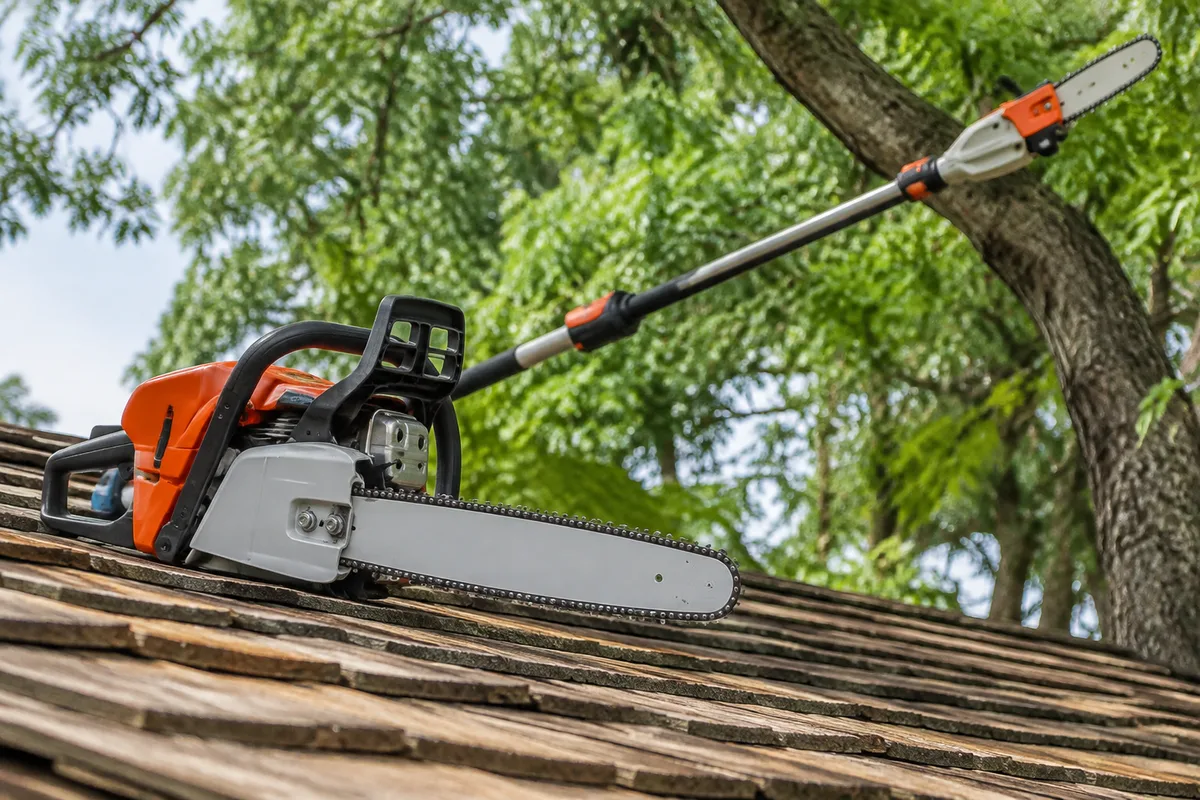
Chainsaws & Pole Saws
When a storm drops a limb — or an entire tree — across a roofline, cutting that material away safely is the first job, not the last. SoffitSmith by Smithbuilt Roofing keeps chainsaws and pole saws on hand so fallen limbs and trees are cut clear of the roof before any repair work begins.
What chainsaws & Pole Saws is
A chainsaw is a gas- or battery-powered cutting tool used to section heavy limbs and trunks into manageable pieces. A pole saw extends that same cutting action on a long handle, letting a crew member reach and remove branches that are lodged against a roof, gutter, or fascia without climbing into an unstable tree or leaning a ladder against damaged framing.
On a roof, the two tools do different jobs. The pole saw handles overhead limbs still tangled in branches above the roof line, cutting them down from a safe distance. The chainsaw takes over once material is on the ground or on the roof surface itself, breaking it into pieces small enough to carry off without dragging whole limbs across shingles, tile, or membrane and causing further damage.
How we use it at SoffitSmith by Smithbuilt Roofing
Tree and limb removal is a first step, not a stand-alone job. Before any inspection or repair can happen, the roof surface has to be clear enough to see what is actually underneath the debris. That is where chainsaws and pole saws come in on a storm or fallen-tree call.
Once the roof is clear, the rest of the on-site equipment can do its work. Moisture meters and wood moisture meters check the decking and framing under and around the impact point. Core sampling tools and a straightforward visual inspection determine whether the damage is limited to the surface layer or reaches the deck. Heavy-duty tarps, battens, and sandbags go down if the opening needs to be weathered in before repairs, and roll-off dumpsters or dump trailers take the cut branches and debris off the property.
This work pairs naturally with related services such as fallen tree impact repair, post-storm damage assessment, and emergency tarping and board-up. Clearing the debris is what makes an accurate assessment possible in the first place.
What it means for you
The main benefit is safety. Cutting a fallen limb or tree off a roof is not a job for a homeowner with a hand saw and a ladder — the material is heavy, often unstable, and can shift while it is being cut. Having the right tools and a plan for how a piece will fall or roll matters more than most people expect.
There is also a practical benefit to sequence: clearing debris first means the actual roof damage can be seen and assessed accurately, instead of guessed at from the ground or estimated around branches still lying across the shingles. That clearer view generally means a more accurate scope of repair and less back-and-forth later.
Finally, getting debris off promptly reduces the chance that a limb sitting on wet shingles or membrane causes secondary damage — trapped moisture, crushed tile, or a punctured membrane — while everyone waits to schedule a full repair.
What to expect during your visit
A visit involving fallen tree or limb removal typically starts with a walk-around from the ground to judge how the material is resting on the roof and whether it is stable enough to approach directly. If overhead branches are still tangled in a tree near the roof, those are addressed first with a pole saw from a safe position before anyone gets close to the roof surface.
Once the area is stable, material on the roof is cut into smaller sections with a chainsaw and carried or lowered off rather than dragged, to limit additional scuffing or puncturing of the surface. Cut debris is bagged or piled for removal, and the crew then does a visual and hands-on check of the area that was covered — looking for cracked tile, torn membrane, dented metal, or exposed decking.
Timing depends heavily on the size of the tree or limb and how it is positioned, so it is handled case by case rather than on a fixed schedule. Homeowners should expect noise from the saws and some foot traffic on the property while debris is carried out, and it helps to keep the area clear of vehicles and pets until the crew confirms the site is clean.
Is it safe to have a chainsaw crew working on my roof?
Cutting fallen trees or limbs off a roof carries real risk, which is why it is treated as a distinct step handled with fall protection, stable footing, and a clear plan for how each cut piece will come down. It is not something to attempt with a ladder and a hand saw on your own roof.
How long does tree or limb removal usually take?
It depends entirely on the size of the tree, how it is positioned on the roof, and how much of it is still attached to standing branches overhead. Smaller limbs can be cleared quickly, while a fallen tree resting across a roofline takes longer to section and remove safely.
Will removing the tree or limb damage my roof further?
Care is taken to cut material into sections and carry or lower it away rather than drag it across the roof surface, which limits additional scuffing or puncturing. Even so, the point of this step is to reveal existing damage clearly, not to guarantee there is none underneath.
Does this apply to any type of roof?
Fallen limb and tree removal comes up on shingle, tile, metal, and flat membrane roofs alike, since storm damage does not discriminate by roofing material. The approach to cutting and clearing is adjusted to protect whatever surface is underneath.
If a fallen tree or limb has come down on your roof, reach out to SoffitSmith by Smithbuilt Roofing to talk through what needs to happen next.