Airless Sprayers, Rollers & Squeegees
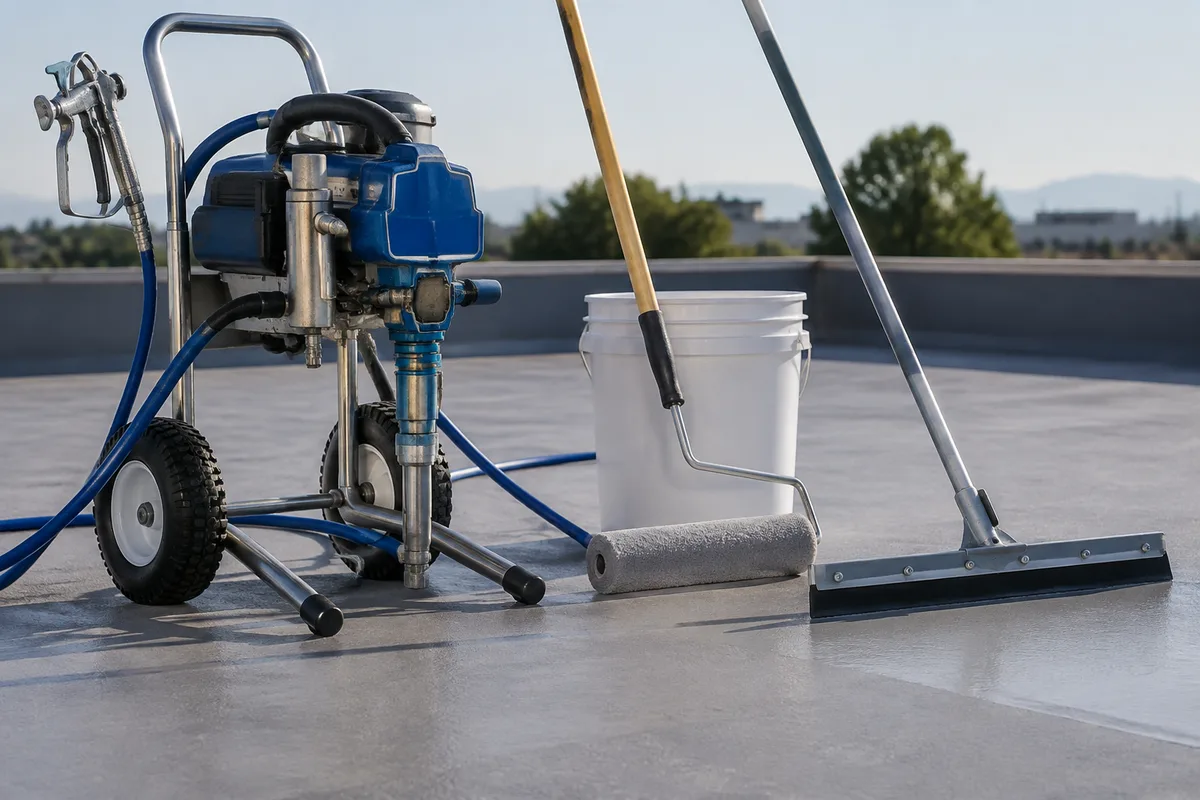
Airless Sprayers, Rollers & Squeegees
Roof coatings only work if they go on evenly, at the right thickness, over the whole surface. Airless sprayers, rollers, and squeegees are the equipment that makes that possible on a real roof, in real weather, across a real schedule. This page covers what the equipment is, how it fits into a coating or restoration project, and what to expect if your roof is a candidate for it.
What airless Sprayers, Rollers & Squeegees is
An airless sprayer pushes liquid coating material through a small tip at high pressure, breaking it into a fine, even spray without mixing in compressed air. That matters because air-assisted spraying can create overspray, uneven droplet size, and inconsistent film build. Airless equipment lays down a more uniform coat and wastes less material in the process.
Rollers and squeegees are not backup tools — they do the work a sprayer cannot. Rollers work coating into seams, laps, fastener heads, and rough textures so the material actually bonds rather than sitting on top. Squeegees pull coating across flat fields to control thickness and push it into low spots, which is exactly where a roof coating needs to be thick enough to matter. Most coating jobs use all three: spray for coverage and speed, roller for detail and penetration, squeegee for thickness control on the flats.
How we use it at SoffitSmith by Smithbuilt Roofing
On roofs where a silicone, acrylic, or elastomeric coating is the right call, this is the equipment that applies it — with attention to full, even thickness rather than a quick pass that looks fine from the ground. Coating work at SoffitSmith by Smithbuilt Roofing starts before the sprayer ever comes out. Moisture meters and core sampling tools help confirm the deck and existing roofing are dry and sound enough to coat rather than replace, since coating over a wet substrate does not solve the underlying problem. Any ponding or drainage issues get checked and addressed as part of the same visit where that applies.
Photo documentation through our CompanyCam app runs alongside the coating work, so you can see the surface before application, during coverage, and after cure — the same images our crew is working from. Where a flat roof also has membrane seams nearby, seam rollers and probes are used separately to confirm those details are sound before or after coating, since a coating is not a substitute for a failed seam.
What it means for you
Even application matters more than most homeowners expect. A roof coating that is thin in spots — even spots you cannot see — will fail there first, usually years before the rest of the roof. Airless spraying combined with roller and squeegee work is simply a more consistent way to control that thickness across an entire roof, including the parts that are hard to see from a ladder.
This approach also tends to be faster than hand-application alone, which means less time with equipment and hoses on your property. Because the material goes on in a controlled, even pass, there is generally less overspray landing where it should not, and less rework needed to fix thin spots after the fact.
What to expect during your visit
Before spraying begins, the roof surface is cleaned and inspected, and landscape protection tarps go down around the work area to keep beds, walks, and plantings clear of overspray. Any repairs identified during inspection — a soft spot in the deck, a failed seam, a clogged drain — are typically addressed first, since coating is meant to go over a sound surface, not to hide a problem.
During application, expect to see the crew working in sections: spraying the broad field, then rolling detail areas like penetrations and laps, then squeegeeing flat sections to even out thickness. Coating needs time to cure between coats and before the roof is walked on again, so the timeline depends on the product, the weather, and the size of the roof rather than a fixed number of hours. Afterward, the area is checked, photographed, and cleaned up before the crew leaves.
Frequently asked questions
Is airless spraying safe for the rest of my property?
Landscape protection tarps are put down before spraying starts, and the equipment is set up to keep material on the roof rather than drifting into beds or walkways. Wind and weather conditions are factored into the schedule, since coating should not be applied in conditions that would carry it off target.
How long does a coating application take?
It depends on the size of the roof, the coating product used, and cure time between coats, so there is no single answer. Your project timeline will be discussed as part of the estimate once the roof has been inspected.
Does this replace a roof, or work with an existing one?
Coating is applied over an existing roof surface that has been checked and confirmed to be sound and dry, using moisture meters and, where needed, core sampling to verify the substrate first. It is not appropriate for a deck that is wet or structurally compromised — that situation calls for repair or replacement instead.
Is every roof a good candidate for coating?
Not every roof type or condition suits a coating, which is part of why inspection comes first. A roof with sound decking, manageable drainage, and no active leaks is generally a better candidate than one with structural or moisture problems still unresolved.
If you are considering a roof coating, reach out to SoffitSmith by Smithbuilt Roofing to talk through whether airless spraying, rolling, and squeegee application is the right fit for your roof.